
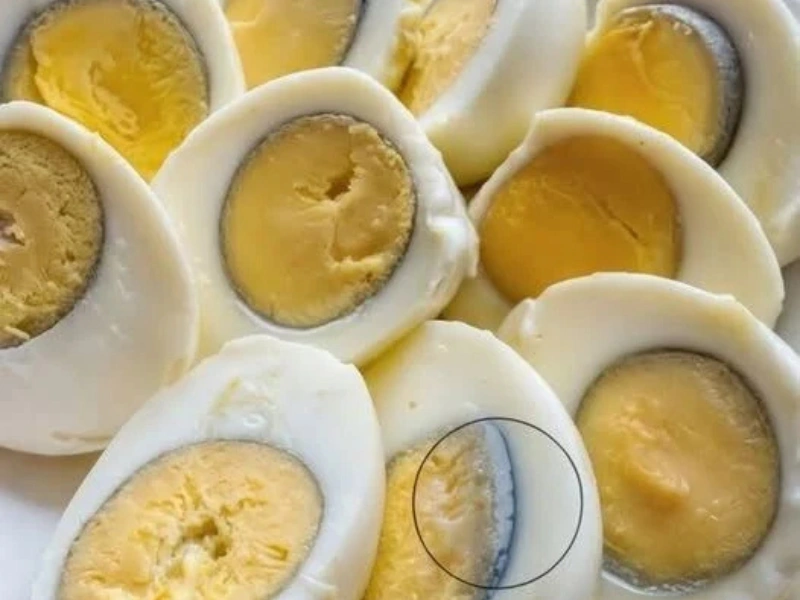
You crack open what should be a perfect hard-boiled egg—and there it is: a faint greenish-gray ring around the yolk. It might look strange, but it’s not a mistake or a sign of spoilage. It’s simply a natural reaction during cooking—and it’s completely harmless.
Let’s break down what’s happening and how you can avoid it if you prefer that bright yellow center.
What Causes the Green Ring?
That gray-green layer forms because of a simple chemical reaction inside the egg:
- As the egg cooks, the white releases sulfur compounds.
- The yolk contains iron.
- When heat is applied for too long, sulfur and iron react at the boundary between the white and yolk, forming ferrous sulfide—the compound responsible for the discoloration.
It may not look appealing, but it doesn’t affect safety or nutrition.
Why It Happens More Often
Some conditions make this reaction more likely:
- Overcooking: Leaving eggs in hot water too long increases the reaction.
- High heat: A rolling boil speeds things up.
- Older eggs: They release sulfur more easily.
- Slow cooling: Keeping eggs in hot water after cooking allows the reaction to continue.
How to Avoid the Green Ring
If you want perfectly yellow yolks, these simple methods help:
1. Gentle Heat + Ice Bath (Most Reliable)
- Place eggs in a pot and cover with cold water.
- Bring to a gentle boil.
- Once boiling, remove from heat, cover, and let sit for 9–12 minutes.
- Transfer immediately to ice water for at least 5 minutes.
Why it works: It prevents overcooking and stops the reaction instantly.
2. Steaming Method
- Bring a small amount of water to a boil with a steamer basket.
- Add eggs and cover.
- Steam for about 12 minutes.
- Cool in ice water.
Bonus: Eggs are often easier to peel this way.
3. Oven Method (For Large Batches)
- Preheat oven to 165°C (325°F).
- Place eggs in a muffin tin.
- Bake for 30 minutes.
- Cool in an ice bath.
Extra Tips for Better Eggs
- Use eggs that are a few days old—they peel more easily.
- Let eggs sit at room temperature briefly before cooking to reduce cracking.
- Cool them quickly after cooking to stop further reactions.
- Peel under running water for smoother results.
Already Got the Green Ring?
No problem—it’s still perfectly safe to eat.
If appearance matters:
- Chop eggs for salads or spreads.
- Slice thinly so the ring is less noticeable.
- Or just ignore it—it doesn’t change the taste.
Common Questions
Is it safe to eat?
Yes, completely.
Does it mean the egg is spoiled?
No. Spoiled eggs have a bad smell or unusual texture—not just a colored ring.
Does shell color matter?
No difference. Brown and white eggs behave the same.
Final Thought
That green ring is just a small chemistry lesson inside your kitchen. It’s harmless—and easy to avoid once you know how.
Perfect eggs are nice, but even imperfect ones are still delicious.